
Choosing Implant Crown Materials: Impact on Bone Health
Dental Expert
TABLE OF CONTENTS
When patients plan an implant, most of their attention goes to the implant itself — its brand, size and success rate. Far fewer people think about the crown that sits on top, yet the choice of implant crown materials influences how chewing forces travel through the implant and into your jaw bone. Because an implant has no shock-absorbing ligament like a natural tooth, every bite is transmitted directly to bone, and researchers have studied in detail how different materials shape that force. Here is what the science shows, and how it guides material selection at Taki Dent.
Why an Implant Tooth Handles Force Differently
A natural tooth is suspended in its socket by the periodontal ligament — a thin, elastic cushion rich in nerve endings that dampens impact and warns you when you bite too hard. A dental implant is fused rigidly to the bone through osseointegration. There is no cushion and no early-warning system.
This is why biomechanics matters so much in implant dentistry. The crown, the abutment (the connector between crown and implant) and the implant itself form a rigid column. How chewing stress distributes along that column — and where it concentrates in the surrounding bone — is affected by the materials each component is made from. Excessive, poorly distributed stress at the bone level is one of the factors implicated in marginal bone loss around implants.
What Finite Element Research Shows About Implant Crown Materials
Because we cannot place strain gauges inside living jaw bone, researchers use three-dimensional finite element analysis (FEA): a computer model of the implant, abutment, crown and bone, in which virtual bite forces are applied and the resulting stresses mapped precisely.
A frequently cited study of this kind was published by Kaleli and colleagues (2018) in The Journal of Prosthetic Dentistry. They modelled single implants restored with different customised abutment materials (including titanium and zirconia) combined with different crown materials — among them monolithic zirconia and lithium disilicate — and analysed stress distribution in the implant components and the peripheral bone. The study's noteworthy findings, simplified for patients:
- Every combination tested kept bone stresses within a broadly similar range. No mainstream ceramic crown material produced alarming stress concentrations in the surrounding bone.
- The abutment material influenced how stress travelled through the system, with stiffer abutment materials altering where load concentrated compared with more resilient ones.
- Stiffer, stronger crown materials such as monolithic zirconia tended to transfer load efficiently down the axis of the implant, while the crown material itself mattered less to peripheral bone stress than many assume.
In other words, the research suggests you do not need to fear that choosing zirconia or lithium disilicate will overload your bone — but it also shows the whole system, especially the abutment, should be engineered as one unit rather than assembled from mismatched parts.
Comparing the Main Crown Options for Implants
| Crown material | Biomechanical character | Aesthetics | Typically chosen for |
|---|---|---|---|
| Monolithic zirconia | Very stiff and fracture-resistant; efficient load transfer | Very good with modern translucent grades | Molars, bruxists, full-arch bridges |
| Lithium disilicate (E.max) | Strong glass-ceramic; slightly less rigid than zirconia | Excellent, most lifelike light transmission | Front teeth and premolars in the smile zone |
| Metal-ceramic | Proven metal core with porcelain surface | Good, but opaque with possible grey margin | Selected bridge cases, budget-driven plans |
All three are legitimate options with long clinical histories. The decision is about matching material behaviour to the position in the mouth, the patient's bite force, the opposing teeth and the aesthetic demands — not about one material being universally "best".
How This Evidence Shapes Real Treatment Planning
At our clinic, the biomechanics research translates into a few consistent planning rules for dental implant treatment in Antalya:
- Plan crown and abutment together. Since abutment material influences stress distribution, we select the abutment and crown as a matched system, most often titanium or hybrid abutments under ceramic crowns.
- Reserve maximum stiffness for maximum load. Back teeth and grinding patients receive monolithic zirconia crowns; the aesthetic zone often favours E.max lithium disilicate.
- Balance the bite meticulously. FEA studies apply idealised forces; in real mouths, a premature contact can multiply local stress. Digital occlusal analysis at fitting is therefore standard.
- Protect the investment. A night guard for clenchers and grinders reduces the cyclic overload that no material choice can fully compensate for.
- Monitor the bone. Follow-up radiographs let us confirm that marginal bone levels remain stable year after year.
Dr. Taki's Clinical Perspective
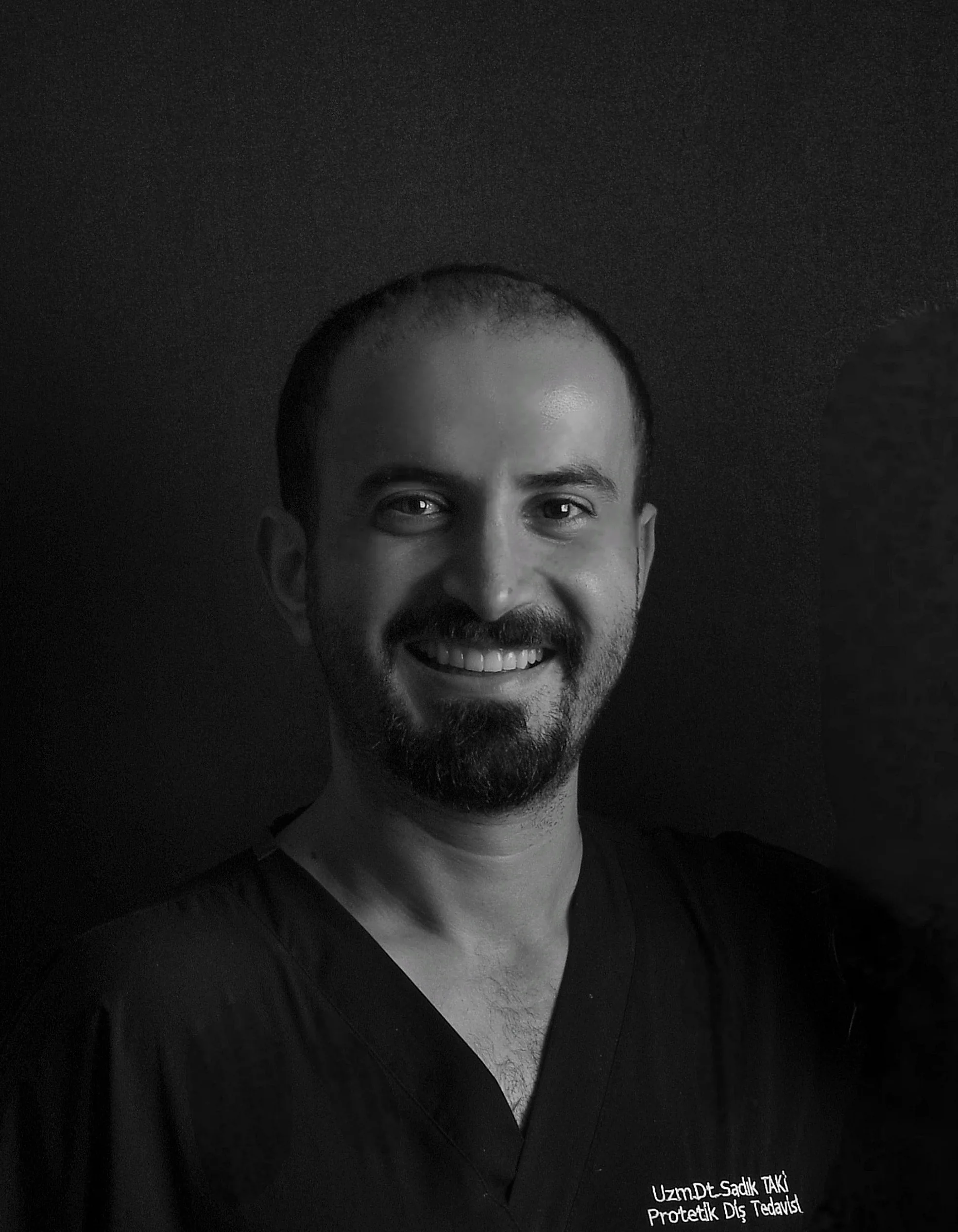
Patients sometimes arrive convinced that one crown material will "protect" their bone and another will destroy it. The finite element evidence, including the Kaleli study, is more reassuring and more subtle: mainstream ceramic options all perform acceptably at the bone level, and the bigger levers are the abutment choice, the fit, and the occlusion. As a prosthodontist, I spend far more time perfecting the bite on an implant crown than debating ceramics — because that is where the research says the risk really lives.
Material selection is one piece of a larger picture that includes implant positioning, bone quality and your habits. If you are comparing options and costs for single implants or full-arch solutions, our current price list shows what each restoration type involves.
Scientific References
This article reflects current peer-reviewed evidence. Key sources include:
- Kaleli, N., Saraç, D., Külünk, S., & Öztürk, Ö. (2018). Effect of different restorative crown and customized abutment materials on stress distribution in single implants and peripheral bone: A three-dimensional finite element analysis study. The Journal of Prosthetic Dentistry. https://doi.org/10.1016/j.prosdent.2017.03.008
Evidence summarised for patient education by Dr. Sadık Taki. Individual outcomes vary; book a consultation for personalised advice.
Planning an implant and unsure which crown material suits your bite and bone? Book a free consultation and receive a recommendation grounded in the evidence.
Ready to Transform Your Smile?
Book your free consultation with our specialist team today.
Schedule Consultation